How to Read a Pure Tone Audiogram
Published 25 June 2026 · Updated 13 July 2026
A complete guide to interpreting pure tone audiograms — the axes, symbols, normal range, air-bone gap, hearing loss patterns, and degree classification every clinician needs to know.
The pure tone audiogram is the fundamental investigation in hearing assessment. Every otology consultation, every hearing complaint, and every pre-operative hearing evaluation produces one. Yet most students and junior doctors describe audiograms rather than read them — they know the vocabulary without the visual literacy. This article builds that literacy from the ground up: what the graph actually represents, how to extract the pattern, and how to translate that pattern into a clinical conclusion.
What the Audiogram Measures
A pure tone audiogram measures hearing threshold — the softest sound a patient can just detect — at a series of discrete frequencies. It does not measure speech understanding, dynamic range, or tolerance to loud sounds. It measures one thing: the minimum audible level at each tested frequency.
The test is conducted in a soundproofed booth. Pure tones (single-frequency sine waves) are delivered through headphones (air conduction) and through a vibrator placed on the mastoid process (bone conduction). For each frequency, the audiologist finds the threshold by presenting tones at decreasing levels until the patient can no longer respond, then confirming at the lowest level where response is reliable.
Reading the Axes
The audiogram is a graph with two axes. Both axes run in a direction that is initially counterintuitive, and getting them wrong inverts every interpretation.
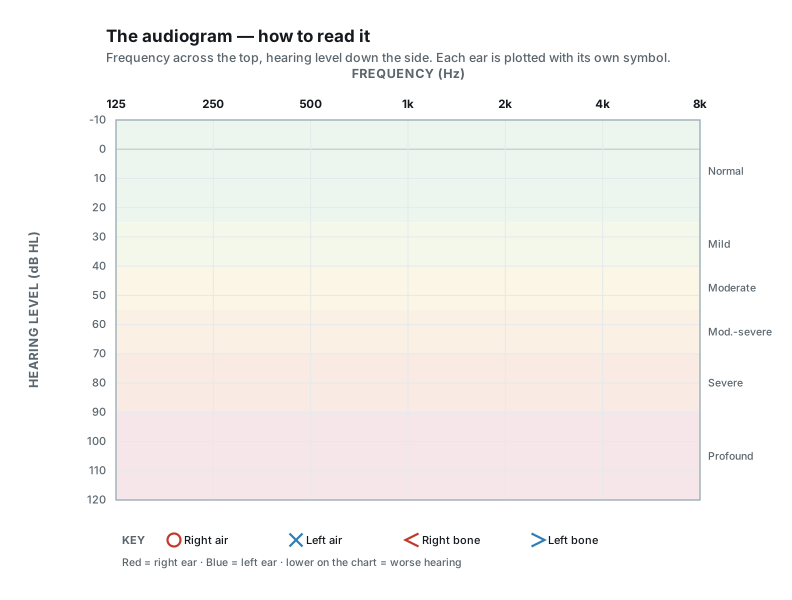
Horizontal axis — Frequency (Hz) Frequencies run from low (250 Hz, left) to high (8000 Hz, right). The tested frequencies are typically 250, 500, 1000, 2000, 4000, and 8000 Hz — a six-octave span covering the speech range and beyond. Occasionally 3000 Hz and 6000 Hz are added. The speech banana — the frequency and intensity range occupied by conversational speech — falls between approximately 500–4000 Hz at 20–60 dB HL.
Vertical axis — Hearing level (dB HL) This axis runs from 0 dB HL at the top to 120 dB HL at the bottom. This is the critical inversion: better hearing is at the top of the graph, worse hearing at the bottom. The 0 dB HL line is not silence — it is the average threshold of young adults with normal hearing, calibrated internationally. A threshold plotted lower on the graph means the patient needs a louder sound to hear it, which means worse hearing.
If you take one thing from this section: down = worse, up = better.
Symbols on the Audiogram
Four symbols represent the four core measurements. Mixing them up makes every pattern unreadable.
| Symbol | Measurement | Ear |
|---|---|---|
| O (circle) | Air conduction | Right |
| X (cross) | Air conduction | Left |
| < or [ | Bone conduction | Right |
| > or ] | Bone conduction | Left |
By convention, right ear findings are plotted in red, left ear findings in blue. The air conduction symbols (circles and crosses) are plotted at the patient’s threshold for that frequency via headphones. The bone conduction symbols (brackets) are plotted at the threshold for vibration delivered directly to the skull.
When masking is applied to the non-test ear during bone conduction (see below), masked BC symbols are shown with a vertical tick through the bracket: ⊏ for right, ⊐ for left.
What is the Air-Bone Gap?
At any given frequency, the vertical distance between the air conduction threshold (circle or cross) and the bone conduction threshold (bracket) is the air-bone gap (ABG). This is the single most diagnostically important feature of the audiogram.
- No ABG (AC ≈ BC): the conductive pathway is functioning normally. Any hearing loss is sensorineural.
- ABG present (AC worse than BC): the conductive pathway is impaired. Bone conduction is preserved because it bypasses the outer and middle ear, so the BC threshold reflects cochlear function. The AC threshold is elevated because sound cannot be transmitted efficiently through the damaged conductive mechanism.
A significant ABG is conventionally defined as ≥10–15 dB between AC and BC thresholds at a given frequency. The maximum achievable ABG from middle ear disease alone is approximately 55–60 dB — the full transformer gain of the ossicular chain. An ABG exceeding 60 dB suggests either ossicular discontinuity or a concurrent sensorineural component.
Normal Hearing
A threshold of 25 dB HL or better at all frequencies is considered normal in adults. This threshold is the upper boundary of normal in clinical practice (some guidelines use 20 dB HL for paediatric populations). Both AC and BC thresholds fall at or above the 25 dB HL line in a normal audiogram. There is no ABG.
Patterns of Hearing Loss
Conductive Hearing Loss
Air conduction thresholds are elevated (pushed down on the graph). Bone conduction thresholds are normal (within 25 dB HL). An air-bone gap is present at the affected frequencies. The shape is typically flat across frequencies because middle ear disease impairs all frequencies fairly equally.
Classic examples: tympanic membrane perforation (moderate flat loss), otosclerosis (predominantly low-frequency CHL, often with a characteristic dip at 2 kHz called Carhart’s notch), otitis media with effusion (flat moderate loss with flat tympanogram).
Sensorineural Hearing Loss
Both air and bone conduction thresholds are elevated and parallel each other. There is no air-bone gap — the AC and BC symbols sit at the same level because both pathways are equally impaired by cochlear or neural damage. The shape varies significantly by cause:
- High-frequency sloping loss: presbycusis, noise-induced hearing loss. Thresholds are near-normal at low frequencies and progressively worse toward 4000–8000 Hz.
- 4 kHz notch: the acoustic trauma notch. Threshold dips sharply at 4000 Hz with relative recovery at 8000 Hz. Pathognomonic of noise-induced hearing loss.
- Flat loss: Menière’s disease (early = low-frequency loss; late = flat severe loss). Sudden SNHL.
- Cookie-bite (mid-frequency loss): some congenital and hereditary losses. Thresholds worst at 1000–2000 Hz with better hearing at extremes.
Mixed Hearing Loss
Both AC and BC thresholds are elevated, but AC is worse than BC — an air-bone gap is present on top of an elevated BC baseline. The sensorineural component raises the BC threshold above normal; the conductive component raises the AC threshold further still.
Degree of Hearing Loss
The severity of hearing loss is classified by the pure tone average (PTA) — the average of thresholds at 500, 1000, and 2000 Hz (the speech frequencies). Some protocols add 4000 Hz.
| Degree | PTA Range (dB HL) |
|---|---|
| Normal | ≤25 dB HL |
| Mild | 26–40 dB HL |
| Moderate | 41–55 dB HL |
| Moderately severe | 56–70 dB HL |
| Severe | 71–90 dB HL |
| Profound | >90 dB HL |
This classification (after Clark, 1981) is the one used in most clinical and examination contexts. In conductive loss, the degree is calculated from the AC thresholds. In sensorineural loss, either AC or BC thresholds can be used (they should match).
Masking — Why it Matters and When it’s Needed
When a sound is played to one ear, it can cross the skull and be perceived by the opposite cochlea if it is loud enough. This transcranial transmission attenuates the signal by approximately 40 dB for air-conducted sounds and 0–10 dB for bone-conducted sounds (the skull transmits vibration efficiently with minimal attenuation between sides).
The clinical consequence: if the test ear has severe hearing loss but the non-test ear is normal, a pure tone delivered to the test ear may be heard by the contralateral cochlea before the test ear’s threshold is reached. The audiogram will then reflect the good ear’s threshold plotted on the bad ear’s side — a shadow audiogram.
To prevent this, the non-test ear is masked with a noise (usually narrowband noise centred on the test frequency) loud enough to prevent it from hearing the test signal. Masking is required whenever:
- The AC threshold difference between ears exceeds 40 dB
- Bone conduction is being tested in any patient with an air-bone gap or asymmetric AC thresholds
Unmasked bone conduction thresholds in asymmetric hearing loss are not interpretable without confirmation that the better ear was appropriately masked. This is examined regularly and missed regularly.
A Step-by-Step Reading Framework
When an audiogram is placed in front of you, work through this in order:
- Check which ear you are reading — right (red, circles) or left (blue, crosses). Read each ear separately before comparing.
- Plot the overall level — are the thresholds above or below 25 dB HL? Is there hearing loss at all?
- Check for an air-bone gap — are BC thresholds better than AC thresholds? If yes, there is a conductive component.
- Describe the shape — flat, high-frequency slope, notch at 4 kHz, cookie-bite, or rising (rare).
- Calculate the PTA — average 500, 1000, and 2000 Hz to get the degree of loss.
- State the type — conductive, sensorineural, or mixed.
- Compare both ears — is the loss symmetric or asymmetric? Asymmetric SNHL (>15–20 dB average between ears) requires investigation for retrocochlear pathology.
Key Numbers
| Parameter | Value |
|---|---|
| Normal hearing threshold (adults) | ≤25 dB HL |
| Speech banana range | ~500–4000 Hz, 20–60 dB HL |
| Significant air-bone gap | ≥10–15 dB |
| Maximum conductive ABG | 55–60 dB (full ossicular chain loss) |
| Acoustic trauma notch | 4000 Hz |
| ABG >60 dB suggests | Ossicular discontinuity or mixed loss |
| Transcranial attenuation (AC) | ~40 dB |
| Transcranial attenuation (BC) | ~0–10 dB |
| Asymmetric SNHL threshold | >15–20 dB PTA difference — investigate retrocochlear |
| Carhart’s notch | 2000 Hz dip in otosclerosis |
Frequently Asked Questions
Why are thresholds plotted going downward when worse hearing is “lower”? The vertical axis shows hearing level — the amount of amplification needed to reach threshold. More amplification needed = more hearing loss = plotted lower. The convention places better hearing at the top because a graph that improves downward is visually unintuitive for most other measurements. You adapt to it quickly once you stop fighting it.
How does the audiogram relate to the tuning fork tests? Tuning fork tests (Rinne, Weber) are bedside screens for the same physiological reality the audiogram measures objectively. A negative Rinne at 512 Hz corresponds to a conductive air-bone gap of at least 20 dB on the audiogram. The Weber lateralisation maps to the direction of the larger conductive or sensorineural asymmetry. When the two don’t agree, recheck both — a masking error on the audiogram or a false-negative Rinne are the common explanations.
What is speech audiometry and how does it differ from pure tone audiometry? Pure tone audiometry measures thresholds for single-frequency tones. Speech audiometry measures the patient’s ability to understand speech — typically as a speech reception threshold (the level at which 50% of words are correctly repeated) and a word recognition score (the percentage of words correctly identified at a comfortable loudness). A patient can have a perfectly reconstructable pure tone audiogram but poor speech understanding — this dissociation suggests retrocochlear pathology or central auditory processing disorder and is clinically important.
What is a type B tympanogram and how does it relate to the audiogram? Tympanometry measures middle ear pressure and compliance separately from hearing threshold. A type B (flat) tympanogram indicates reduced compliance of the tympanic membrane and middle ear system — typically from fluid (otitis media with effusion), perforation, or wax occlusion. A type B tympanogram with a large ear canal volume suggests a perforation; a type B with normal canal volume suggests effusion. When a flat tympanogram coexists with a flat conductive pattern audiogram, the two investigations confirm middle ear pathology from different angles.
Can I read an audiogram correctly without masking information? Not reliably in asymmetric cases. If the audiogram shows bone conduction thresholds that are identical in both ears in a patient with markedly asymmetric air conduction, suspect a shadow audiogram — the BC thresholds may both be reflecting the better ear’s cochlea. Always check whether masking was applied before interpreting BC findings in any ear with significant AC asymmetry.
References
Topics
Related
Instruments
Procedures