Otosclerosis — Presentation and Diagnosis
Published 25 June 2026 · Updated 13 July 2026
Otosclerosis is the most common cause of progressive conductive hearing loss in adults without ear disease. This article covers the pathology, clinical presentation, audiometric pattern including Carhart's notch, and the diagnostic workup.
Otosclerosis is a disease of the otic capsule — the dense bone surrounding the cochlea and labyrinth — in which abnormal bone remodelling leads to the deposition of highly vascular, spongy bone (otospongiosis) that replaces the normal dense enchondral bone. When this process involves the region of the oval window and the anterior footplate of the stapes, the stapes footplate becomes progressively fixed to its bony margin by a fibrous-then-bony ankylosis, and conductive hearing loss develops. It is the most common cause of progressive hearing loss in young adults without history of ear infection or trauma in populations of European descent, and it is one of the few causes of conductive hearing loss that produces no otoscopic abnormality in its typical form.
Pathology
The temporal bone is unique in that its otic capsule is the only bone in the adult body that does not undergo normal bone remodelling after ossification is complete in infancy. Otosclerosis is a focal breakdown of this remodelling arrest — specific sites within the otic capsule undergo resorption and replacement with cellular, vascular bone.
The most common and clinically important focus is the fissula ante fenestram — a small connective tissue cleft just anterior to the oval window, which is a normal developmental remnant. Otosclerotic foci here grow progressively and extend onto the annular ligament of the stapes, fixing the footplate. As fixation increases, ossicular mobility decreases and conductive hearing loss progresses.
Less commonly, otosclerotic foci involve the cochlear endosteum — the bone lining the inner surface of the scala tympani. Cochlear otosclerosis causes a sensorineural or mixed hearing loss by direct toxic effects on the cochlear endolymph (altered ion composition from diseased endosteal bone) or by mechanical compression of cochlear structures. This is why approximately 10–15% of patients with otosclerosis develop a sensorineural component as the disease progresses.
Epidemiology
Prevalence: Clinical otosclerosis (causing symptomatic hearing loss) affects approximately 0.3–0.4% of the white adult population. Histological otosclerosis (microscopic foci without clinical hearing loss) is found in approximately 8–10% of temporal bone autopsy studies — far more common than clinically apparent disease (Declau et al., 2001).
Demographics:
- Most common in people of European descent; relatively uncommon in African and Asian populations
- Female predominance: approximately 2:1 female-to-male ratio
- Onset typically in the second to fourth decades of life
- Bilateral in approximately 70–80% of cases, though often asymmetric
Genetics: Autosomal dominant inheritance with approximately 25–40% penetrance. A positive family history is found in approximately 25% of patients. Multiple genetic loci have been identified, reflecting genetic heterogeneity.
Pregnancy: Oestrogen accelerates otosclerosis — many women first notice hearing loss during or after pregnancy. Fluoride (sodium fluoride) was historically used to slow disease progression by stabilising the otic capsule bone, though its use is now largely discontinued due to uncertain long-term benefit.
Viral hypothesis: There is circumstantial evidence linking measles virus (paramyxovirus) to otosclerosis — measles RNA has been detected in otosclerotic foci, and the declining incidence of otosclerosis in some European populations has been attributed in part to measles vaccination. This remains a hypothesis rather than established causation.
Clinical Presentation
Progressive Bilateral Conductive Hearing Loss
The hallmark: a slowly progressive conductive hearing loss, typically beginning in one ear before becoming bilateral. The progression is variable — some patients notice little change over years; others progress substantially within months. There is no pain, no otorrhoea, and no vertigo in typical otosclerosis.
The onset of noticeable hearing difficulty in the second or third decade of life in a patient with no history of ear disease or noise exposure, particularly a woman who first noticed it during or after pregnancy, is the classic presentation.
Tinnitus
Low-frequency tinnitus is common — often described as a low hum or buzz, sometimes paracusis. It is present in approximately 75% of patients with significant otosclerosis.
Paracusis Willisii
A characteristic and pathognomonic symptom: paradoxical improvement in hearing in noisy environments. Normal-hearing people raise their voices in noise, inadvertently providing amplification that the patient with conductive loss can benefit from. Because their inner ear (cochlea) is normal, the amplified sound is processed efficiently. Patients may describe hearing better in restaurants, on public transport, or at parties — environments where others are speaking more loudly.
This is the otosclerosis symptom that appears most commonly in examination questions.
Otoscopic Examination
The tympanic membrane in otosclerosis is entirely normal in appearance. There is no effusion, no perforation, no retraction. The ear canal is clean. The drum moves normally. The only abnormal finding on otoscopy is:
Schwartze sign (flamingo-pink blush): In active, highly vascular otosclerosis, the highly vascular spongy bone of the otosclerotic focus transmits a pink discolouration through the intact tympanic membrane — visible as a reddish or pink blush in the anteroinferior quadrant of the drum (the area overlying the promontory adjacent to the oval window). This sign indicates active, vascular disease and is present in a minority of patients (approximately 10%). Its absence does not exclude otosclerosis.
Audiometric Pattern
The audiogram in otosclerosis is diagnostic when interpreted correctly and is almost always requested before any intervention is considered.
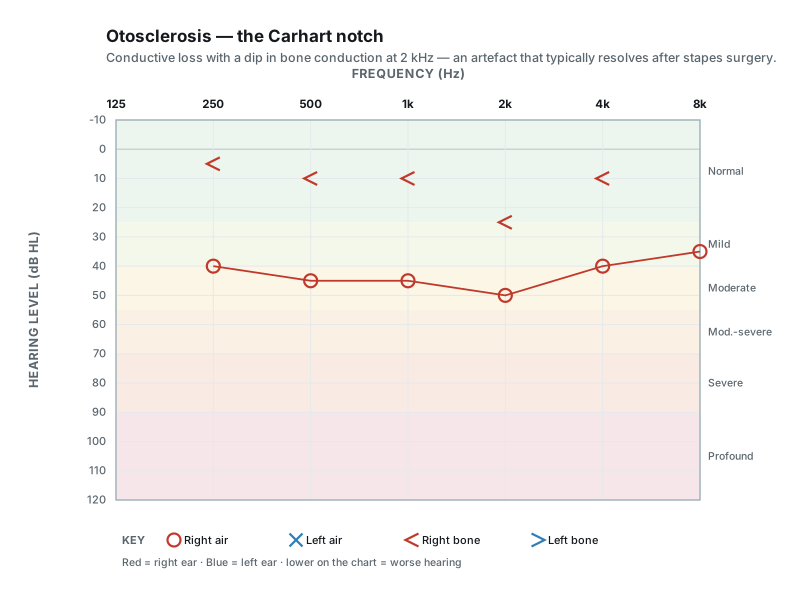
Air conduction thresholds: Initially elevated preferentially in the low frequencies (250–500 Hz), because stiffness of the middle ear system impedes low-frequency transmission more than high-frequency. As disease progresses, the loss extends to higher frequencies.
Bone conduction thresholds: Largely preserved, reflecting an intact cochlea — this is the defining feature of a conductive hearing loss. However, there is a characteristic dip in bone conduction at 2000 Hz that appears despite intact cochlear function. This is the Carhart’s notch.
Carhart’s Notch
The Carhart’s notch is not a sensorineural loss — it is a mechanical artefact. At 2000 Hz, the normal ossicular chain has a resonance effect that contributes to the measured bone conduction threshold. When the stapes is fixed and this resonance effect is abolished, bone conduction thresholds appear artificially elevated — specifically, approximately 5 dB at 500 Hz, 10 dB at 1000 Hz, 15 dB at 2000 Hz, and 5 dB at 4000 Hz. The maximum dip at 2000 Hz is the characteristic shape.
After successful stapedectomy, the resonance effect is restored and the Carhart’s notch disappears — this is one confirmation that the notch is mechanical rather than cochlear. An examiner who sees a bone conduction dip at 2000 Hz in the absence of any other SNHL finding should think immediately of otosclerosis.
Air-bone gap: Present, predominantly at low frequencies in early disease, broadening across frequencies as fixation progresses. The gap can approach 55–60 dB in severe stapes fixation.
Tympanometry
Tympanogram in otosclerosis is characteristically:
Type As (shallow peak): The compliance of the middle ear system is reduced by the stiff, partially or completely fixed stapes. The tympanogram shows a peak at approximately normal pressure (around 0 daPa) but with reduced height — a shallow peak. This distinguishes otosclerosis from otitis media with effusion (Type B, flat, no peak) and from a normal ear (Type A, normal peak height).
Acoustic reflexes: Absent ipsilaterally in early to moderate otosclerosis. The stapedius reflex requires the stapes to move — a fixed stapes cannot produce the reflex. Absent acoustic reflexes with an otherwise normal-appearing audiogram in a young adult are a red flag for otosclerosis (or other ossicular fixation, such as malleus bar).
Absent ipsilateral reflexes with present contralateral reflexes, in the context of a Type As tympanogram and low-frequency conductive hearing loss, is the classical tympanometric pattern of stapes fixation.
CT Temporal Bones
High-resolution CT of the temporal bones (HRCT) can demonstrate otosclerotic foci as areas of lucency (decreased density) adjacent to the oval window — the halo sign around the cochlea in cochlear otosclerosis. CT is not required for diagnosis in typical cases where the clinical, audiometric, and tympanometric picture is consistent, but it is useful to confirm diagnosis before surgery, assess cochlear involvement, and identify anatomical variants relevant to stapedectomy.
Key Numbers
| Parameter | Value |
|---|---|
| Clinical prevalence (white adults) | ~0.3–0.4% |
| Histological prevalence (autopsy) | ~8–10% |
| Bilateral disease | ~70–80% |
| Female-to-male ratio | ~2:1 |
| Onset age | Second to fourth decade |
| Carhart’s notch maximum dip | 15 dB at 2000 Hz |
| Schwartze sign prevalence | ~10% |
| Family history positive | ~25% |
Frequently Asked Questions
How is otosclerosis differentiated from otitis media with effusion on investigation? Both produce conductive hearing loss with a normal otoscope (though OME often shows a dull, retracted drum with limited mobility). The key differentiator is tympanometry: OME produces a Type B (flat, no peak) tympanogram because the fluid reduces all compliance; otosclerosis produces a Type As (shallow peak present) tympanogram because the system is stiff but not fluid-filled. Acoustic reflexes are absent in both, but the tympanogram shape distinguishes them clearly. Audiometric shape also differs: OME typically produces a flat loss; otosclerosis produces a characteristic low-frequency predominance with Carhart’s notch.
Why is otosclerosis more common in women and worsened by pregnancy? Oestrogen appears to activate osteoclast-mediated bone resorption in the otic capsule, accelerating the formation of the vascular spongy otosclerotic focus. Progesterone may also contribute. Historically, women were advised against pregnancy in severe otosclerosis — this is no longer standard advice, but it explains the association. Fluoride supplementation was proposed as a stabiliser during pregnancy in this context, though current evidence does not strongly support routine use.
Does otosclerosis cause vertigo? Classical stapes-footplate otosclerosis does not typically cause significant vertigo. However, in far-advanced disease with cochlear endosteal involvement, or in cases where the otosclerotic focus extends to the posterior semicircular canal or vestibular system, vestibular symptoms can occur. Vertigo in a patient with known otosclerosis should prompt reassessment — it may indicate cochlear otosclerosis progression, or an unrelated vestibular diagnosis.
References
Topics