Types of Hearing Loss — Conductive, Sensorineural, and Mixed
Published 25 June 2026 · Updated 13 July 2026
A clear breakdown of the three types of hearing loss — conductive, sensorineural, and mixed — covering their causes, audiogram patterns, clinical findings, and the key thresholds every student needs to know.
Hearing loss is classified by where in the auditory pathway the problem arises. Get that right, and the clinical findings, audiogram pattern, tuning fork results, and management options follow logically. Get it wrong, and you are trying to memorise disconnected facts. The three types — conductive, sensorineural, and mixed — describe three different anatomical failure points, each with a distinct fingerprint on clinical examination and audiometry.
The Auditory Pathway — A Quick Map
Sound travels in two stages before reaching conscious perception. First, mechanical energy: sound waves vibrate the tympanic membrane, which moves the ossicular chain (malleus → incus → stapes), which pushes the stapes footplate into the oval window, setting cochlear fluid in motion. Second, electrochemical conversion: the basilar membrane deflects, the hair cells of the organ of Corti depolarise, and the signal travels as electrical impulses along the cochlear nerve (CN VIII) to the brainstem and auditory cortex.
The first stage — from the outer ear to the oval window — is the conductive pathway. The second — cochlea and nerve onwards — is the sensorineural pathway. A problem in either produces a different type of hearing loss. A problem in both produces mixed loss.
Conductive Hearing Loss
What it is
Conductive hearing loss (CHL) results from any obstruction or disruption to the mechanical transmission of sound from the outer ear to the oval window. The cochlea and auditory nerve are intact and functioning. The problem is getting sound to them.
Common causes
Outer ear: cerumen impaction, foreign body, otitis externa with canal oedema, exostoses, atresia.
Middle ear: tympanic membrane perforation, acute otitis media with effusion (fluid in the middle ear), chronic suppurative otitis media (CSOM), ossicular discontinuity, ossicular fixation (otosclerosis — stapes footplate fixed to the oval window margins), cholesteatoma eroding the chain, tympanosclerosis.
How it looks on audiometry
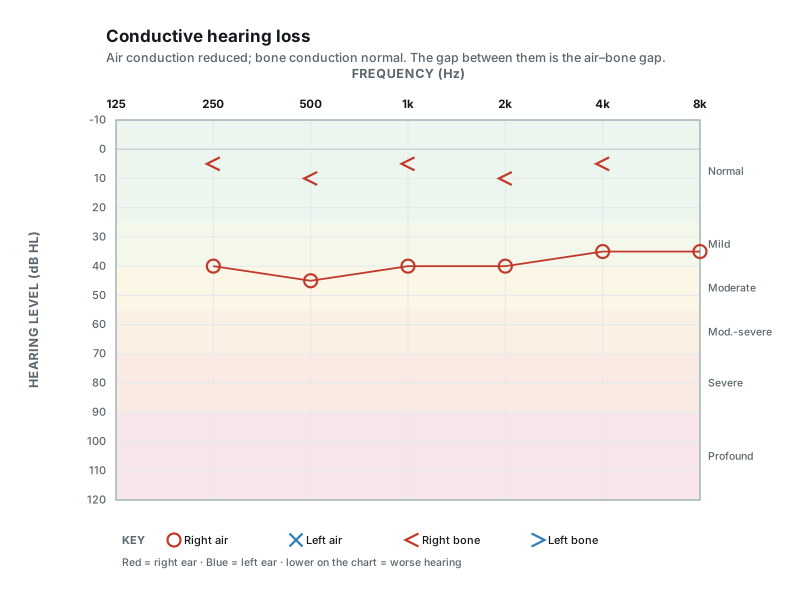
In a pure-tone audiogram, air conduction (AC) thresholds are elevated — the patient can’t hear soft sounds through the normal ear route — but bone conduction (BC) thresholds are normal or near-normal, because the cochlea still responds when vibration bypasses the middle ear and is delivered directly to the skull.
The gap between AC and BC thresholds on the audiogram is called the air-bone gap (ABG). An ABG is the signature finding of conductive hearing loss.
| Audiogram Feature | Conductive HL |
|---|---|
| Air conduction | Elevated (worse than normal) |
| Bone conduction | Normal or near-normal |
| Air-bone gap | Present |
| Shape | Usually flat across frequencies |
Maximum conductive gap
The ossicular chain can only produce a limited amount of conductive gain. The maximum air-bone gap achievable by middle-ear disease alone is approximately 55–60 dB. This is the complete gain of the middle-ear transformer, and it corresponds to total stapes fixation (as in advanced otosclerosis).
An audiogram showing an air-bone gap greater than 60 dB should raise suspicion that the gap is not purely conductive — there may be concurrent sensorineural loss contributing, or the audiometry technique needs checking.
Tuning fork findings
- Rinne: Negative (BC > AC) in the affected ear
- Weber: Lateralises to the affected ear
Key point
Conductive hearing loss is, in many cases, surgically or medically reversible. Wax removal restores hearing immediately. Tympanoplasty can close a perforation. Stapedectomy can release a fixed footplate. The cochlea is unharmed — it simply needs sound delivered to it more effectively.
Sensorineural Hearing Loss
What it is
Sensorineural hearing loss (SNHL) results from damage to the cochlea (sensory loss) or the cochlear nerve and its central connections (neural loss). The mechanical transmission pathway through the outer and middle ear is intact. Sound reaches the cochlea normally — but is not converted to signal effectively, or the signal is not transmitted adequately.
In practice, most SNHL in clinical ENT is cochlear (sensory), not neural, and involves loss or damage to the hair cells of the organ of Corti. Neural SNHL (retrocochlear loss) — from acoustic neuroma, CN VIII damage, or brainstem pathology — is less common but critically important not to miss.
Common causes
Age-related: Presbycusis — the most common cause of SNHL overall. Progressive bilateral high-frequency loss, symmetrical, beginning in the 4–6 kHz range. Part of normal ageing; cochlear hair cell attrition is the primary mechanism.
Noise-induced: Occupational or recreational noise exposure. Bilateral, high-frequency, typically worst at 4 kHz (the acoustic trauma notch). Hair cell damage from mechanical and metabolic stress in the basal cochlea.
Sudden SNHL: Unilateral loss appearing within 72 hours, >30 dB across three consecutive frequencies. Idiopathic in most cases (viral, vascular, or immune theories). ENT emergency — requires urgent investigation and corticosteroid treatment.
Infections: Bacterial meningitis (severe bilateral SNHL via cochlear ossification), mumps (unilateral), congenital CMV.
Ototoxic drugs: Aminoglycoside antibiotics (gentamicin, amikacin, tobramycin), cisplatin and carboplatin, loop diuretics at high doses. Most ototoxic agents damage the basal cochlea first, producing high-frequency loss.
Menière’s disease: Fluctuating SNHL with vertigo, tinnitus, and aural fullness. Low-frequency loss early; becomes flat and severe with disease progression.
Acoustic neuroma (vestibular schwannoma): Unilateral progressive SNHL, typically with tinnitus and absent acoustic reflex. Retrocochlear pattern on ABR. Must be excluded in any asymmetric SNHL.
Congenital: CONNEXIN 26 (GJB2) gene mutations — the most common genetic cause of congenital SNHL worldwide.
How it looks on audiometry
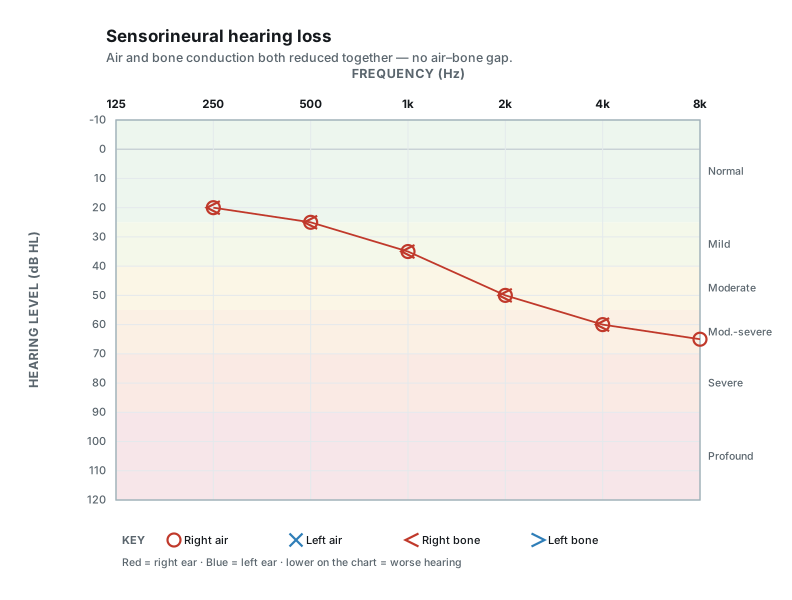
Both AC and BC thresholds are elevated and track together. There is no air-bone gap — when both pathways are equally impaired, the mechanical bypass that creates a gap does not exist.
| Audiogram Feature | Sensorineural HL |
|---|---|
| Air conduction | Elevated |
| Bone conduction | Elevated, matches AC |
| Air-bone gap | Absent (or <10 dB) |
| Shape | Varies: high-frequency slope (presbycusis, noise), flat (Menière’s late), cookie-bite (some congenital) |
Tuning fork findings
- Rinne: Positive (AC > BC) — normal result, because neither pathway is mechanically blocked; the cochlea is simply less sensitive
- Weber: Lateralises to the better-hearing ear
- Caution: False negative Rinne — see the Rinne and Weber test article for full explanation
Key point
SNHL is predominantly non-reversible with current treatment. The exception is sudden SNHL (systemic corticosteroids within 2–4 weeks of onset improve outcomes) and some immune-mediated cochlear conditions. Management otherwise focuses on amplification (hearing aids) and, in severe-to-profound cases, cochlear implantation.
Mixed Hearing Loss
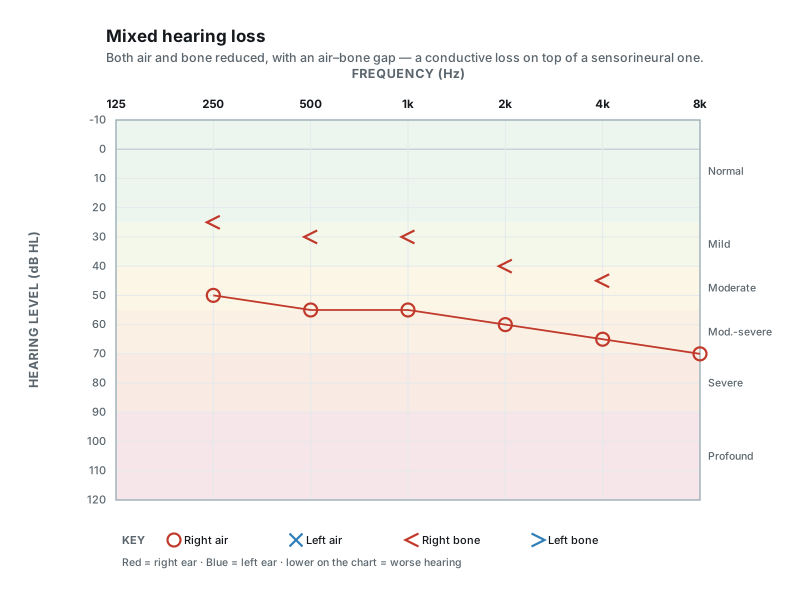
Mixed hearing loss has both a conductive and a sensorineural component in the same ear. The audiogram shows elevated AC thresholds, elevated BC thresholds, and an air-bone gap — the gap reflects the conductive component on top of the underlying sensorineural baseline.
| Audiogram Feature | Mixed HL |
|---|---|
| Air conduction | Elevated |
| Bone conduction | Elevated (but better than AC) |
| Air-bone gap | Present |
Common scenarios
- CSOM in an elderly patient with presbycusis — the perforation or middle-ear pathology adds a conductive loss on top of age-related cochlear decline
- Otosclerosis in a patient with noise-induced SNHL — the fixed stapes produces a conductive gap over a sensorineural baseline
- Temporal bone fracture involving the otic capsule — fracture line disrupts both the ossicular chain (conductive) and the cochlea (sensorineural)
- Longstanding CSOM with cochlear involvement — chronic infection and its mediators can eventually damage cochlear hair cells, converting what was a pure CHL into a mixed loss
The management principle: address the correctable conductive component first (surgically or medically), then reassess the residual sensorineural baseline before planning rehabilitation.
Distinguishing the Types — Quick Reference
flowchart TD
    A["Hearing loss on the audiogram"] --> B{"Air-bone gap?"}
    B -->|"Absent (AC ≈ BC, both elevated)"| C["Sensorineural"]
    B -->|"Present (AC worse than BC)"| D{"Bone conduction normal?"}
    D -->|"BC normal"| E["Conductive"]
    D -->|"BC also elevated"| F["Mixed"]
| Feature | Conductive | Sensorineural | Mixed |
|---|---|---|---|
| AC threshold | Elevated | Elevated | Elevated |
| BC threshold | Normal | Elevated | Elevated |
| Air-bone gap | Present | Absent | Present |
| Rinne | Negative | Positive | Negative (if gap ≥20 dB) |
| Weber | To affected ear | To better ear | Depends on dominant component |
| Max severity | ~55–60 dB | Any degree | Any degree |
| Reversibility | Often yes | Usually no | Conductive component may be |
Key Numbers
| Parameter | Value |
|---|---|
| Maximum conductive air-bone gap | 55–60 dB |
| ABG >60 dB suggests | Discontinuity, or SN overlap |
| Sudden SNHL threshold | >30 dB loss across 3 consecutive frequencies within 72 hours |
| Acoustic trauma notch | 4 kHz |
| Significant asymmetric SNHL | >15–20 dB average between ears — investigate for retrocochlear pathology |
Frequently Asked Questions
Can a patient have both ears with different types of loss? Yes, and this is common. One ear may have pure CHL (perforated drum from CSOM) while the other has SNHL (noise-induced). Each ear is classified independently. The audiogram always shows both ears separately — never let the better ear’s result obscure what is happening in the worse ear.
Is tinnitus a type of hearing loss? No. Tinnitus is a symptom — the perception of sound without an external source — that can accompany any type of hearing loss, or occur in isolation. It is not a classification category. Its presence alongside SNHL, particularly if unilateral, warrants investigation for retrocochlear pathology.
What is the difference between cochlear and retrocochlear SNHL? Cochlear SNHL originates in the hair cells of the organ of Corti — noise damage, presbycusis, Menière’s, ototoxicity. Retrocochlear SNHL originates in CN VIII or its central connections — acoustic neuroma, meningitis affecting the nerve, demyelinating disease. The distinction matters because retrocochlear pathology on one side requires MRI to exclude an acoustic neuroma. Key clinical clues: acoustic reflexes absent or decayed on ABR, poor speech discrimination out of proportion to the pure-tone average, and asymmetric SNHL without obvious cochlear cause.
How much conductive hearing loss does a tympanic membrane perforation cause? A small to moderate perforation produces approximately 15–30 dB of conductive loss, depending on size and position. A very large perforation with an intact ossicular chain may produce up to 40 dB of loss. The hearing loss from a perforation alone rarely reaches 60 dB — a flat 55–60 dB loss with a perforation should raise suspicion of associated ossicular damage.
References
- Flint PW, Haughey BH, Lund VJ et al (eds). Cummings Otolaryngology — Head and Neck Surgery. 7th ed. Elsevier, 2021. (Audiologic evaluation; classification of hearing loss.)
- Watkinson JC, Clarke RW (eds). Scott-Brown's Otorhinolaryngology, Head and Neck Surgery. 8th ed. CRC Press, 2018. (Conductive, sensorineural and mixed hearing loss.)
- World Health Organization. World Report on Hearing. Geneva: WHO; 2021. (Grades of hearing loss and global burden.)
- Chandrasekhar SS, Tsai Do BS, Schwartz SR et al. Clinical Practice Guideline: Sudden Hearing Loss (Update). Otolaryngol Head Neck Surg. 2019;161(1_suppl):S1–S45.
Topics
Related
Instruments
Procedures
Articles
- Presbycusis — Age-Related Hearing Loss
- Noise-Induced Hearing Loss — Mechanism, Pattern, and Prevention
- Otosclerosis — Presentation and Diagnosis
- How to Read a Pure Tone Audiogram
- Rinne and Weber Test — How to Perform and Interpret Results
- Beyond Rinne and Weber — Other Tuning Fork Tests
- How We Hear — Impedance Matching and Cochlear Mechanics