Noise-Induced Hearing Loss — Mechanism, Pattern, and Prevention
Published 1 July 2026 · Updated 13 July 2026
Noise-induced hearing loss is the most preventable cause of sensorineural hearing loss. This article covers the hair cell damage mechanism, the characteristic 4 kHz audiometric notch, the difference between temporary and permanent threshold shift, and hearing conservation principles.
Noise-induced hearing loss (NIHL) is the most common cause of acquired sensorineural hearing loss in working-age adults worldwide, and one of the most preventable. The World Health Organization estimates that over 1 billion young people are at risk of hearing loss due to unsafe recreational noise exposure. Every clinician who sees a patient with hearing loss needs to ask about noise exposure — because the pattern is specific and the cause is always environmental.
The Physics of Noise Exposure
Sound intensity is measured in decibels (dB SPL). The decibel scale is logarithmic: a 10 dB increase represents a 10-fold increase in sound intensity, and approximately a doubling of perceived loudness. This has critical implications for hearing damage:
- 85 dB — the internationally accepted threshold above which hearing protection is mandatory with 8-hour daily exposure (OSHA, WHO)
- 94 dB — safe duration drops to 1 hour per day
- 100 dB — safe duration approximately 15 minutes
- 110 dB — safe duration approximately 2 minutes
- 120 dB — immediate risk of acoustic trauma
Most nightclubs, concerts, and power tools operate at 100–115 dB. Firearms produce peak levels of 140–165 dB — well above the threshold for immediate acoustic trauma.
Mechanism of Hair Cell Damage
The cochlea receives acoustic energy via the travelling wave, which reaches maximum amplitude at the region of the basilar membrane tuned to the incoming frequency. The outer hair cells (OHCs) in this region bear the greatest mechanical stress and are the primary targets of noise damage.
Metabolic Exhaustion
At moderate-to-high intensities, sustained noise exposure causes metabolic exhaustion of the OHCs — the intense mechanical activity requires ATP at a rate that exceeds the hair cell’s oxidative capacity. Glutamate excitotoxicity at the inner hair cell (IHC) synapse also contributes. This produces a temporary threshold shift (TTS) — hearing worsens during and immediately after exposure, then recovers over hours to days as the metabolic disturbance resolves.
TTS is the familiar “muffled hearing” and tinnitus experienced after a loud concert. If recovery is complete, no permanent damage occurred. If the same ear is re-exposed before full recovery, or if exposure is sufficiently intense or prolonged, damage accumulates.
Mechanical Destruction
At higher intensities or with cumulative damage, the stereocilia of the OHCs are physically sheared or buckled beyond their elastic limit. The tip-link connections between stereocilia (which gate the mechanosensory ion channels) break. With sufficient damage, the OHC body itself undergoes apoptosis or necrosis. This is permanent threshold shift (PTS) — irreversible hair cell loss that produces lasting sensorineural hearing loss.
Crucially, mammalian cochlear hair cells do not regenerate after loss. Unlike non-mammalian vertebrates (birds, fish) which can regenerate hair cells, human and primate cochlear hair cells are permanently lost once destroyed. This is why NIHL is irreversible.
The 4 kHz Notch — Why That Frequency?
The characteristic NIHL audiogram shows a notch at 4000 Hz (4 kHz), with partial recovery at 8 kHz. Several factors explain why 4 kHz is specifically vulnerable:
- Resonance effect: The external ear canal has a resonance frequency of approximately 3–4 kHz, amplifying incoming sound by approximately 10–15 dB at these frequencies. Sounds in this range arrive at the cochlea more intensely than their ambient level suggests.
- Basilar membrane geometry: The region of the basilar membrane tuned to 4 kHz is particularly susceptible — it is exposed to maximum mechanical stress from a range of lower frequencies via a “roll-off” effect in the travelling wave mechanics.
- Blood supply: The 4 kHz region of the cochlea is relatively remote from both the spiral ganglion blood supply (basal) and the strial blood supply (apical), making it more vulnerable to ischaemic injury during sustained noise stress.
The notch is bilateral and symmetric in occupational NIHL (since both ears receive equal occupational noise exposure). An asymmetric notch raises the question of unilateral noise exposure (e.g., firearms: the leading ear in a right-handed shooter receives a larger blast) or an additional diagnosis.
TTS vs PTS — The Clinical Distinction
| Feature | Temporary Threshold Shift (TTS) | Permanent Threshold Shift (PTS) |
|---|---|---|
| Recovery | Full, within hours to days | No recovery |
| Mechanism | Metabolic fatigue, reversible | Hair cell destruction, irreversible |
| Audiogram | Threshold shift, returns to baseline | Fixed notch remains |
| Tinnitus | Present acutely, resolves | May become chronic |
| Prevention | Noise avoidance, recovery time | Too late — use hearing conservation |
The transition from TTS to PTS is gradual and not felt by the patient. People often do not notice NIHL until it has progressed to involve the speech frequencies (500–3000 Hz), because the 4 kHz notch does not initially impair conversational hearing. By the time the patient presents with “difficulty hearing,” the loss is already substantial. This is why audiometric surveillance in noise-exposed workers matters.
Audiometric Pattern
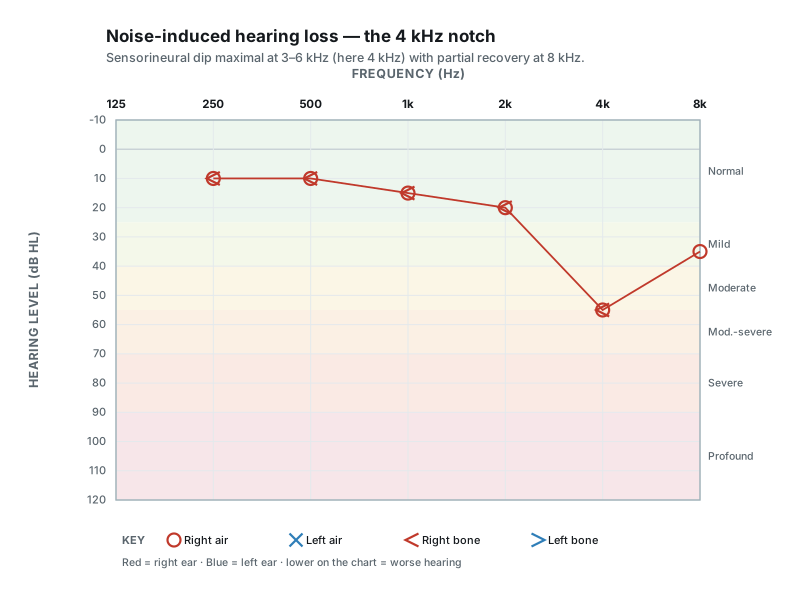
The NIHL audiogram is recognised by:
- Bilateral, symmetric sensorineural hearing loss (AC and BC parallel, no air-bone gap)
- Notch at 4 kHz — the defining feature
- Partial recovery at 8 kHz — thresholds at 8 kHz are usually better (higher on the audiogram = worse hearing) than at 4 kHz, giving the characteristic notch shape rather than a progressive slope
- Near-normal thresholds at 250–2000 Hz in early disease — the speech frequencies are initially preserved
- Progression with continued exposure — the notch widens and deepens over years of cumulative noise exposure, eventually involving 2 kHz and below
The partial 8 kHz recovery is a distinguishing feature from presbycusis, which shows a continuously worsening slope up to and including 8 kHz (no notch recovery). In a patient with both conditions — a common clinical reality — the two patterns are superimposed and may be difficult to separate.
Acoustic Trauma vs Chronic NIHL
Chronic NIHL: The typical pattern — years of occupational or recreational noise exposure producing gradual, usually asymptomatic 4 kHz notch. Patients present late, often when colleagues notice they are mishearing.
Acoustic trauma: A single, very intense sound exposure (explosion, firearms blast, industrial accident). Produces immediate severe hearing loss, tinnitus, and sometimes fullness or otalgia. The audiogram may show a broader, deeper loss than the gradual NIHL pattern — sometimes a flat severe SNHL affecting all frequencies. Recovery over 24–72 hours is possible if hair cell damage is metabolic rather than mechanical, but often there is a significant permanent component. Treatment in the acute phase is controversial — high-dose corticosteroids have been used, but evidence is limited.
Hearing Conservation — The Key Principles
NIHL is entirely preventable. The hierarchy of noise control:
- Engineering controls: Reduce the noise at source — quieter machinery, acoustic enclosures, vibration damping. This is the most effective approach.
- Administrative controls: Limit exposure time, rotate workers, schedule noisy tasks, enforce quiet recovery periods.
- Personal protective equipment (PPE): Ear defenders (muffs) or earplugs as a last resort. Earmuffs provide approximately 20–30 dB attenuation; properly fitted foam earplugs provide 25–33 dB. The key word is “properly fitted” — most workers underfill foam plugs and achieve far less attenuation than the rated value.
Personal exposure limit: In most occupational health frameworks (UK COSHH, OSHA), an action level of 80–85 dB(A) over 8 hours triggers hearing protection programmes; a limit of 85–87 dB(A) mandates hearing protection use. Exposure above 140 dB peak is prohibited regardless of duration.
Key Numbers
| Parameter | Value |
|---|---|
| Action level for hearing protection | 80–85 dB(A) over 8 hours |
| Exposure limit | 85–87 dB(A) over 8 hours |
| Peak exposure limit (impulse noise) | 140 dB peak |
| Frequency of 4 kHz notch | 4000 Hz (4 kHz) |
| Canal resonance peak | ~3–4 kHz (~10–15 dB amplification) |
| Earplug attenuation (foam, properly fitted) | ~25–33 dB |
| Earmuff attenuation | ~20–30 dB |
| Hair cell regeneration in humans | None — permanent loss |
| Occupational NIHL — global estimated cases | >16% of disabling hearing loss |
Frequently Asked Questions
Is tinnitus always present in NIHL? Tinnitus is extremely common in NIHL — present in over 70% of patients — but not universal. It is often the first symptom patients notice, typically high-pitched (correlating with the frequency of hair cell loss), and may precede measurable audiometric change. Chronic tinnitus from NIHL can be the most distressing symptom — the hearing loss itself is often well-tolerated compared to persistent high-pitched tinnitus. Tinnitus from a single noise exposure typically resolves if adequate recovery time is given; tinnitus from accumulated damage may be permanent.
Is NIHL only occupational? No. Recreational NIHL is increasing rapidly, particularly in young people. Personal music players at high volumes (studies show many young people routinely listen at 85–100 dB through headphones), nightclubs, concerts, motorsport, firearms, and power tools are all important sources. The WHO estimates that 1.1 billion young people (12–35 years) are at risk from recreational noise exposure. This is a public health issue, not only an occupational health one.
If the 4 kHz notch is there but the patient has no complaints, does it matter? Yes. The notch is evidence of hair cell loss — cells that cannot be replaced. The patient has no complaints yet because speech frequencies are preserved, but the reserve has already been eroded. With continued exposure, the notch will widen and involve 2 kHz, at which point conversational difficulty begins. The notch is also a medicolegal finding — its presence documents prior significant noise exposure. Identifying it should prompt noise history, referral for hearing conservation counselling, and follow-up audiometry.
References
Topics