Presbycusis — Age-Related Hearing Loss
Published 25 June 2026 · Updated 13 July 2026
Presbycusis is the most common cause of hearing loss in adults globally. This article covers Schuknecht's four histological types, the audiometric pattern, the relationship between pure tone thresholds and speech discrimination, and the functional impact.
Presbycusis — from the Greek presbys (old man) and akousis (hearing) — is the progressive bilateral sensorineural hearing loss associated with ageing. It is not a single disease but a spectrum of cochlear and neural degenerative changes, and it is the most common sensory impairment in older adults globally. By the sixth decade, approximately 30% of adults have clinically significant hearing loss; by the eighth decade, this rises to over 50%. Despite its prevalence, it is frequently underdiagnosed and undertreated — patients and clinicians often attribute it to normal ageing and delay intervention, when hearing aids or cochlear implantation could significantly improve quality of life and cognitive outcomes.
Schuknecht’s Classification — Four Histological Types
Harold F. Schuknecht, based on temporal bone pathology studies at the Massachusetts Eye and Ear Infirmary, described four primary histological patterns of presbycusis in 1955 and 1993. Each type has a distinct pathological basis and a corresponding audiometric signature.
Type I — Sensory Presbycusis
Pathology: Loss of outer and inner hair cells in the basal turn of the cochlea. The basal turn processes high-frequency sounds; its hair cells are also the most mechanically stressed by every sound that passes through the cochlea, regardless of frequency, making them the first to accumulate damage over a lifetime.
Audiogram: Steeply sloping high-frequency sensorineural hearing loss, with near-normal thresholds at low and mid frequencies. The loss begins at 4 kHz and extends to 8 kHz and above, while 250–2000 Hz thresholds are preserved or only mildly affected.
Speech discrimination: Relatively preserved, because the speech frequencies (500–3000 Hz) are largely unaffected in the early stages.
Type II — Neural Presbycusis
Pathology: Loss of spiral ganglion neurons — the cell bodies of the cochlear nerve fibres in Rosenthal’s canal within the modiolus. Hair cells may be relatively preserved but their output cannot be transmitted efficiently to the brainstem when ganglion cell loss is severe.
Audiogram: Relatively flat or gently sloping loss, without the marked high-frequency drop of sensory presbycusis.
Speech discrimination: Disproportionately poor relative to the pure tone audiogram. Patients may have a moderate pure tone average loss but very poor word recognition scores — they can detect sound but cannot decode speech. This dissociation is the hallmark of neural presbycusis and the most clinically significant feature: patients who say “I can hear but I can’t understand” are describing neural loss.
Neural presbycusis is also associated with reduced benefit from hearing aids (which amplify but do not restore neural discrimination) and is a driver of poor cochlear implant outcomes in older candidates if spiral ganglion loss is severe.
Type III — Metabolic (Strial) Presbycusis
Pathology: Atrophy of the stria vascularis — the metabolically active tissue on the lateral wall of the scala media responsible for maintaining the high endocochlear potential (+80 mV) and the unique high-potassium, low-sodium endolymph composition. Without adequate endocochlear potential, hair cell transduction is impaired even if the cells themselves are intact.
Audiogram: Flat, relatively symmetric sensorineural hearing loss across all frequencies. This is the most distinctively “flat” pattern of presbycusis.
Speech discrimination: Relatively preserved, because the flat loss affects all frequencies proportionately and the neural architecture is intact.
Hereditary component: Strial presbycusis has a strong familial tendency — families where multiple members develop this flat-pattern hearing loss in the sixth or seventh decade are recognised in the literature as showing “familial low-frequency SNHL.”
Type IV — Mechanical (Cochlear Conductive) Presbycusis
Pathology: Stiffening of the basilar membrane and associated structures, reducing the travelling wave amplitude at the base. Since the base processes high frequencies, this produces high-frequency loss similar to sensory presbycusis.
Audiogram: Linear (straight-line) descending slope from low to high frequencies.
Schuknecht acknowledged that most clinical presbycusis is mixed or indeterminate — pure single-type cases are the exception. The majority of patients show a combination of sensory, neural, and strial changes, and the audiogram reflects the dominant contribution at any given point in the disease course.
Clinical Presentation
”I can hear but I can’t understand”
This is the most characteristic complaint of presbycusis — and specifically of neural and sensory types where high-frequency loss disproportionately impairs consonant discrimination. Speech intelligibility depends heavily on consonants (particularly sibilants: /s/, /f/, /th/, /sh/) which are high-frequency sounds. When these are attenuated by the hearing loss, speech becomes audible but unintelligible — patients hear the rhythm and volume of speech but miss the phonemic detail.
Difficulty hearing in background noise is often the first functional symptom — when competing noise fills the lower frequencies and speech must be discriminated from it, the high-frequency loss makes speech impossible to decode.
Bilateral and Symmetric
Presbycusis is almost always bilateral and largely symmetric. A significantly asymmetric hearing loss (>15–20 dB difference between ears) in an older patient should not be attributed to presbycusis without investigation — acoustic neuroma, unilateral Menière’s disease, and other unilateral pathology must be excluded.
Tinnitus
High-frequency tinnitus — a high-pitched hiss or whistle — is present in approximately 70% of patients with sensory presbycusis, corresponding to the deprivation of afferent input to central auditory pathways from hair cell loss at the base.
Accelerating Factors
Age-related cochlear degeneration is a baseline process, but several factors accelerate it:
- Noise exposure (occupational or recreational, cumulative)
- Cardiovascular disease (reduced cochlear blood supply via the stria vascularis)
- Diabetes (microvascular disease affecting the cochlea)
- Ototoxic drug exposure (aminoglycosides, cisplatin, loop diuretics at high doses)
- Smoking
The interaction between noise-induced and age-related loss is additive — a patient who has worked in a noisy environment for decades and is now 70 will typically show a more severe and earlier-onset presbycusis than the norm.
Audiometric Pattern
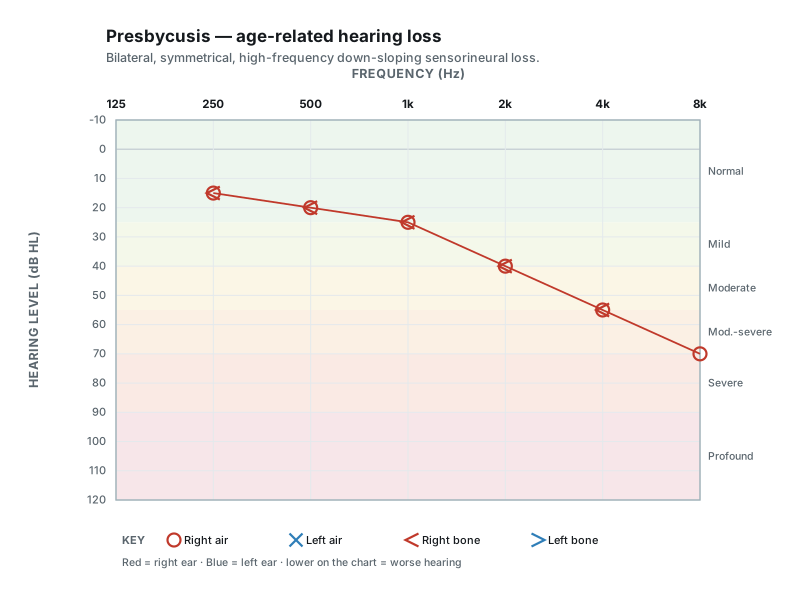
The characteristic audiogram of presbycusis is bilateral, symmetric, high-frequency sensorineural hearing loss — a sloping configuration with thresholds near-normal at 250–500 Hz and progressively worse toward 4000–8000 Hz. Both air conduction and bone conduction are elevated and run parallel (no air-bone gap). The degree of loss progresses slowly over years.
Key audiometric features that distinguish presbycusis from other causes of SNHL:
| Feature | Presbycusis | Noise-induced SNHL | Sudden SNHL |
|---|---|---|---|
| Onset | Gradual, over years | Gradual (cumulative) | Acute (<72 hours) |
| Pattern | High-frequency slope | 4 kHz notch with partial recovery at 8 kHz | Any pattern; often flat |
| Symmetry | Bilateral, symmetric | Bilateral, usually symmetric | Unilateral |
| Age group | Older adults | Any age (exposure history) | Any age |
The 4 kHz notch of noise-induced hearing loss typically shows better thresholds at 8 kHz than at 4 kHz (the “notch” recovers). In pure presbycusis, the high-frequency loss continues to worsen toward 8 kHz without a notch recovery. This distinction can be difficult in patients with mixed noise-induced and age-related changes — which is most elderly patients with occupational noise history.
Cognitive Association
Hearing loss in older adults is independently associated with accelerated cognitive decline and increased risk of dementia. A landmark prospective study (Lin et al., JAMA Internal Medicine 2013) found that even mild hearing loss at baseline was associated with a 1.4-fold increased risk of incident dementia, with moderate hearing loss associated with a 3-fold increase. The mechanism is not fully established — social isolation, reduced cognitive stimulation, and shared neurodegenerative pathways have all been proposed.
This association has changed the clinical framing of presbycusis from a benign sensory inconvenience to a potentially modifiable risk factor for cognitive health. Whether hearing aid use attenuates the cognitive decline remains an active area of research.
Key Numbers
| Parameter | Value |
|---|---|
| Prevalence over 65 years | ~30% with significant hearing loss |
| Prevalence over 75 years | >50% |
| Schuknecht Type I (sensory) | Basal turn hair cell loss; high-frequency slope |
| Schuknecht Type II (neural) | Spiral ganglion loss; poor speech discrimination |
| Schuknecht Type III (strial/metabolic) | Stria vascularis atrophy; flat loss |
| Schuknecht Type IV (mechanical) | Basilar membrane stiffness; linear slope |
| Tinnitus association | ~70% of patients with sensory presbycusis |
| Significant asymmetry threshold | >15–20 dB — investigate further |
Frequently Asked Questions
Why do patients with presbycusis say “I can hear but I can’t understand”? Hearing detection (the pure tone threshold) and speech intelligibility are not the same thing. Detection is measured by the audiogram; intelligibility depends on the pattern of frequency loss and neural processing. High-frequency loss from sensory or neural presbycusis preferentially impairs consonant discrimination — patients hear the vowel sounds (which are low-frequency) but miss the consonants that provide phonemic differentiation between words. In noisy environments, even the vowels become masked, leading to near-complete loss of speech intelligibility despite conversational hearing that seems functional in quiet.
At what age should patients be referred for audiology assessment? Any patient who reports difficulty hearing — regardless of age — warrants an audiogram. Presbycusis does not need to be “severe” to impair function or quality of life. A pragmatic trigger is any complaint of difficulty in noisy environments, frequent requests for repetition, or reliance on lip-reading. Population-based screening at 65 and above is recommended in some guidelines.
Is presbycusis preventable? The age-related component of cochlear degeneration is not preventable. However, the modifiable contributors — noise exposure, cardiovascular risk factors, smoking, ototoxic drug use — are all addressable. Hearing conservation (ear protection in noisy environments, avoiding prolonged high-volume headphone use) throughout life likely delays the onset and slows the progression of the noise-induced component that combines with age-related changes.
References
Topics